Owning a home is still the single biggest financial milestone for most Indian families — and for millions, the Pradhan Mantri Awas Yojana (PMAY) is the bridge that makes it possible. Launched in 2015 under the government's "Housing for All" mission, PMAY has helped crores of families move out of kutcha houses and rented rooms into homes of their own.
If you're planning to buy house , build home , or renovate a house in 2026, this guide breaks down exactly who qualifies, what benefits are on the table, and how to apply — without the confusing government jargon.
What Is PM Awas Yojana?
PMAY is a central government housing scheme designed to provide affordable housing to economically weaker sections (EWS), low-income groups (LIG), and middle-income groups (MIG) across India. It runs through two separate arms:
PMAY-Gramin (PMAY-G): For rural households living in kutcha or dilapidated houses
PMAY-Urban (PMAY-U): For families in cities and towns, now in its second phase — PMAY-U 2.0
Both components work on a Direct Benefit Transfer (DBT) model, meaning financial assistance is credited straight to the beneficiary's Aadhaar-linked bank account, usually in installments tied to construction milestones.
PMAY-Gramin: Eligibility & Benefits
PMAY-G doesn't work through open applications the way many people assume. Instead, beneficiaries are selected from Socio-Economic Caste Census (SECC) data and the Awaas+ survey list, which is verified by local gram sabhas.
Who typically qualifies:
Households with no house, or those living in a kutcha or dilapidated house, that are included in the SECC/Awaas+ list
Priority is given to SC/ST households, minorities, widows, persons with disabilities, and families of martyred defence or paramilitary personnel
Automatic exclusions — even genuinely poor households are disqualified if they already own a kucca house, a motorised vehicle, or a Kisan Credit Card with a limit of ₹50,000 or more, or if they pay income tax. Notably, owning even a motorised two-wheeler is enough to trigger exclusion under PMAY-G rules.
How the money is paid: Assistance under PMAY-G is released in installments linked to construction progress, and verified through geo-tagged photographs. As a bonus, beneficiaries also get roughly 90–95 days of MGNREGA wage support for construction labour, plus assistance for toilet construction under the Swachh Bharat Mission.
How to check your status: If you're in a rural area, the fastest way is to ask your Gram Panchayat whether you're on the PMAY-G/Awaas+ beneficiary list, or search directly on the pmayg.nic.in portal under Stakeholders → IAY/PMAYG Beneficiary.
Related Posts
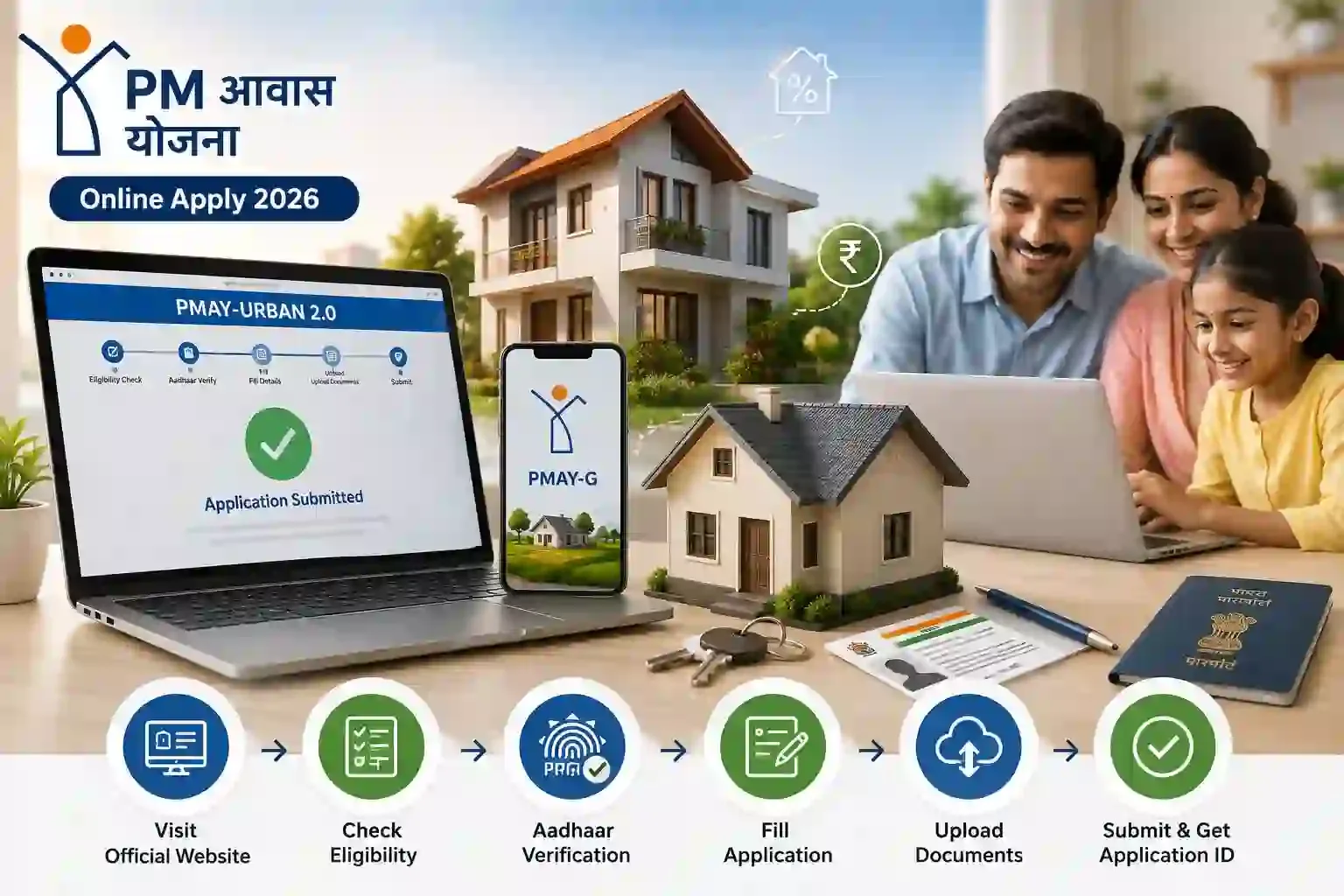
How to Apply for PM Awas Yojana Online in 2026: Complete Step-by-Step Guide (Urban & Gramin)
Full step-by-step process to apply for PMAY-Urban 2.0 and PMAY-Gramin online in 2026 — documents, portal links, eligibility check, home loan interest subsidy, and status tracking.
PMAY-Urban 2.0: What's Changed
For city dwellers, PMAY-U supports EWS, LIG, and MIG families through components such as beneficiary-led construction (BLC), affordable housing in partnership (AHP), and interest subsidy on home loans. A newer addition under PMAY-U 2.0 is the Affordable Rental Housing Complexes (ARHC) initiative, which aims to give urban migrants and the urban poor working in industrial areas and non-formal sectors access to dignified, affordable rental housing close to their workplace.
Core eligibility conditions for urban applicants:
The applicant's family should not already own a kucca house anywhere in India
Falls under EWS, LIG, or MIG income categories (income slabs are periodically revised — always confirm the current bracket on the official PMAY-U portal before applying)
Applying for a first-time home purchase or construction
How to apply/check status: Urban applicants can apply through their Urban Local Body or the state housing portal, and should check current application windows since these open periodically rather than year-round.
Documents You'll Need
Whether you're applying under PMAY-G or PMAY-U, keep these ready — it saves weeks of back-and-forth:
Aadhaar card
Ration card
Identity proof
Income certificate
Domicile certificate
Bank passbook (Aadhaar-linked)
Mobile number and a passport-size photograph
Land-related documents, where applicable
How the Fund Disbursement Works
One detail people often miss: PMAY isn't a lump-sum payout. Financial assistance is transferred directly to the beneficiary's Aadhaar-linked bank account in installments, typically released in stages that correspond to construction progress — such as after the foundation, walls, roof, and final completion. This staged, verified model is why the scheme has managed to keep leakage relatively low compared to older housing subsidy programs.
Common Mistakes That Get Applications Rejected
Applying despite owning a kucca house elsewhere — even a house inherited jointly can trigger disqualification.
Missing Aadhaar-bank linkage — DBT payments fail without this, delaying the entire process.
Incomplete construction documentation — geo-tagged photo verification means skipping stages can pause your installment.
Assuming PMAY-G is application-based — it isn't. If you're not on the SECC/Awaas+ survey list, applying separately won't help; you need to request inclusion during the survey window instead.
Owning excluded assets — a two-wheeler, a KCC above the threshold, or income-tax filing status can silently disqualify an otherwise eligible rural family.
PMAY vs Buying a Home in the Open Real Estate Market
If you don't qualify for PMAY, or you're considering a ready-to-move flat instead of waiting on a government scheme, it helps to know how the numbers typically compare:
Home loan interest rates: Even without a PMAY subsidy, most nationalised and private banks currently offer home loan interest rates in a competitive range for salaried and self-employed applicants with a clean credit history. Comparing offers across 3–4 lenders before signing is usually worth the effort — a lower rate on a 20-year home loan tenure adds up to lakhs in savings.
Builder floor vs apartment vs plot: A builder floor often costs less per square foot than a branded apartment in the same locality, while buying a plot and doing independent home construction gives more control over layout but takes longer and needs active supervision.
Ready-to-move vs under-construction property: Ready-to-move flats skip GST on the purchase (in most cases) and remove construction-delay risk, but under-construction projects are usually priced lower and allow staggered payment linked to construction stages — similar in spirit to how PMAY disbursements work.
Property registration and stamp duty: Budget an extra 5–8% of the property value for stamp duty, registration charges, and legal verification — a cost many first-time buyers underestimate when comparing PMAY-assisted construction with an open-market flat or house purchase.
EMI planning: Whether you're funding a home through PMAY-linked construction or a straight home loan, running the numbers through a home loan EMI calculator before committing helps avoid over-leveraging your monthly budget.
For many first-time buyers, the realistic path is a mix: use PMAY's interest subsidy component (if eligible) to reduce the effective home loan interest rate, while still going through standard real estate due diligence — verified property title, RERA registration for under-construction projects, and a lawyer-reviewed sale agreement.
Is PMAY Worth Applying For in 2026?
For genuinely eligible families, yes — it remains one of the most substantial housing support schemes available anywhere in the country, combining interest relief, direct construction funding, and convergence benefits like MGNREGA wages and toilet construction support. The eligibility net is also wider than most people assume, especially for rural households that assume they need "connections" to get on the list — inclusion is driven by survey data and verified need, not political favour.
Official website :- click here
That said, income slabs, subsidy structures, and application windows are revised periodically, so always cross-check current figures on pmayg.nic.in (rural) or pmay-urban.gov.in (urban) before making financial decisions based on this scheme.
Disclaimer: This article is for informational purposes only and is not affiliated with the Government of India. Scheme details, income slabs, and subsidy amounts are subject to periodic government revision — always verify current terms on the official PMAY portals before applying.